
Πρωτότυπο
To be replayable, a game must first be playable

Like many before me, I spent several weeks of Fall 2024 in the thrall of Balatro. It didn’t take over my life, nor did I persist past the nearly-vertical difficulty curve, but it is an eminently replayable™ game.

After the spell passed, I was still left thinking about what could be done with a standard 52-card deck. The first idea that I actually took the time to test and write up is a riff on Sushi Go called Dim Sum. (It’s reasonably fun; try it!)
But I got the idea stuck in my head that you could build a game around making poker hands, starting with a bad, unfocused deck, and improving your prospects over the course of the game. My first thought was to let cards of each suit do something specific, like draw then discard, add a new card to the deck, modify another card… soon I had come up with more than four abilities that I liked, and before long I had more than 13 (one for each rank).
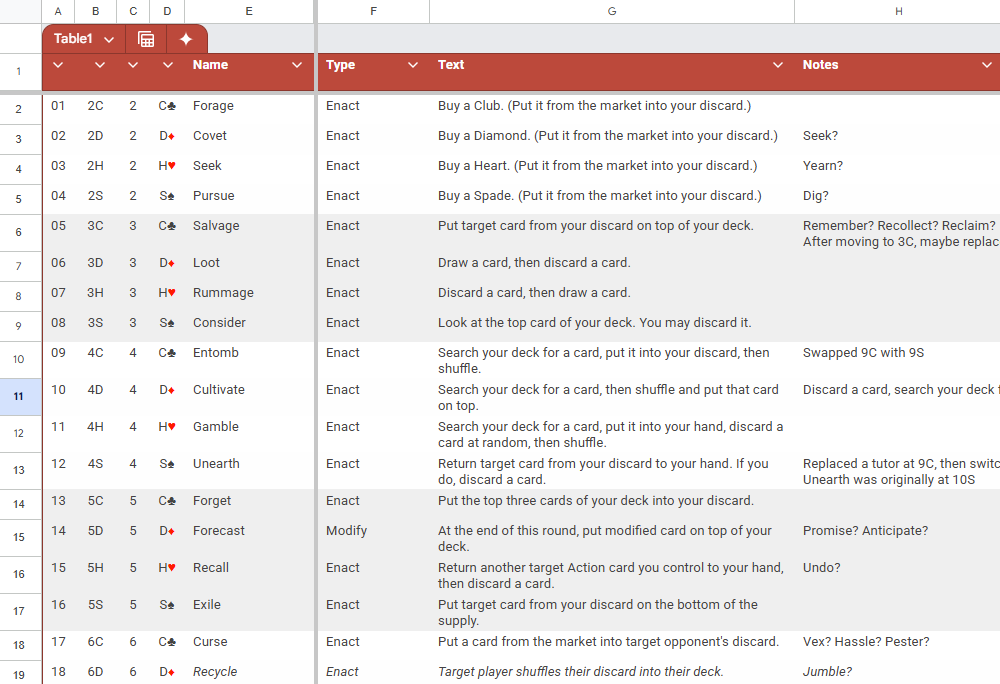
After quite a bit more thinking, I had drafted 52 different card abilities into a spreadsheet.
And from there, with a roll of masking tape and elegant calligraphy, I made my first physical prototype.
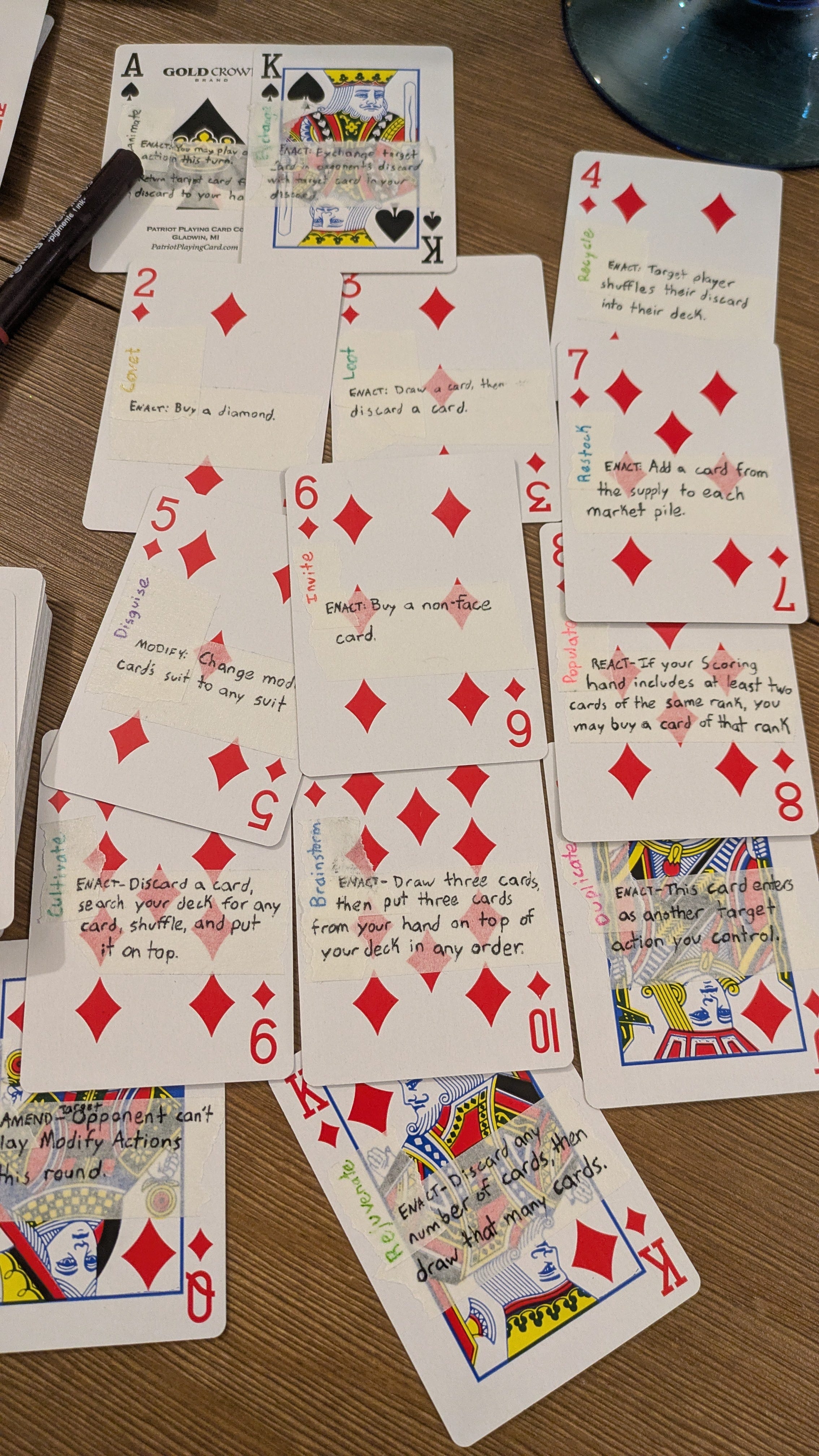
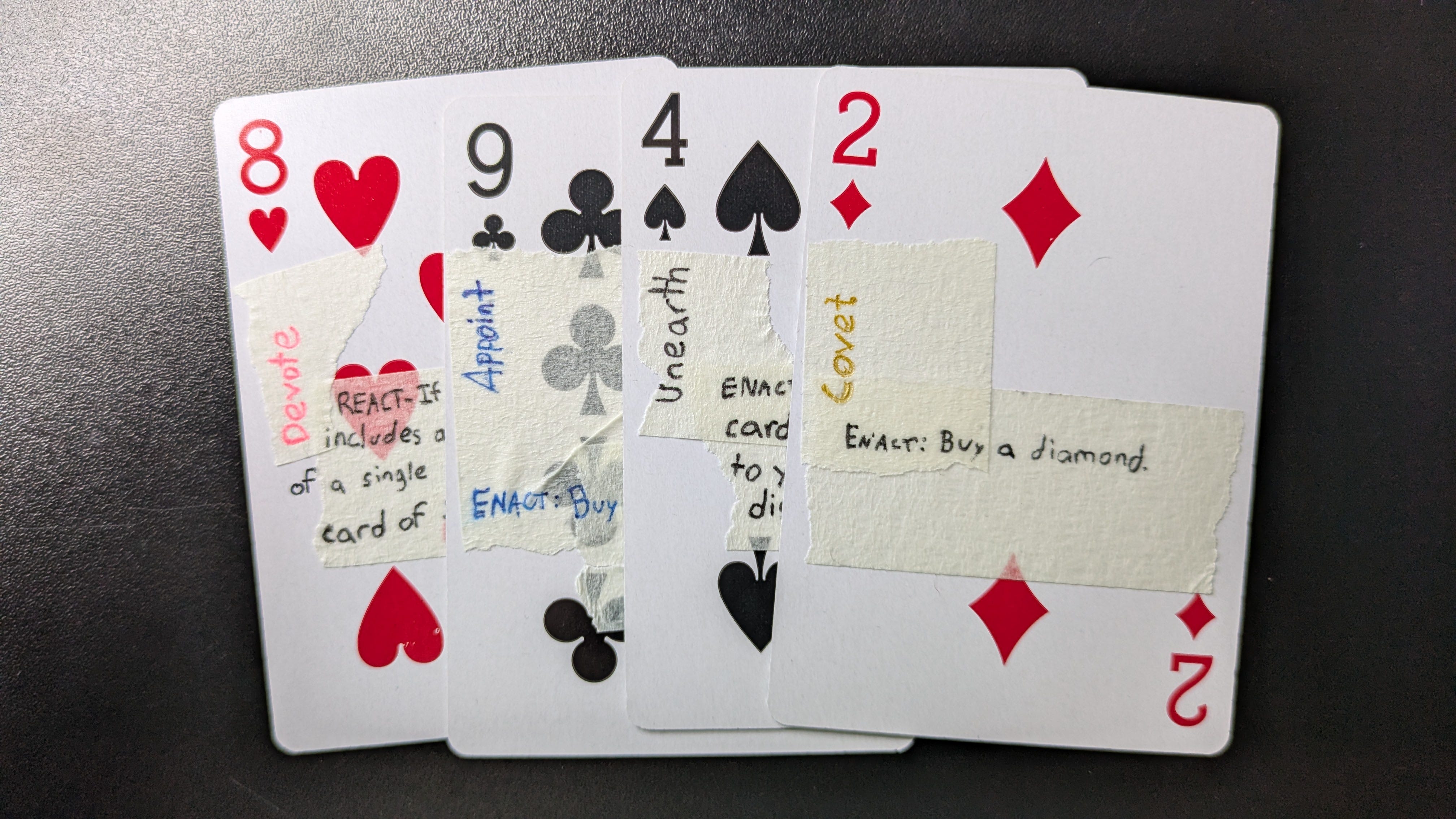
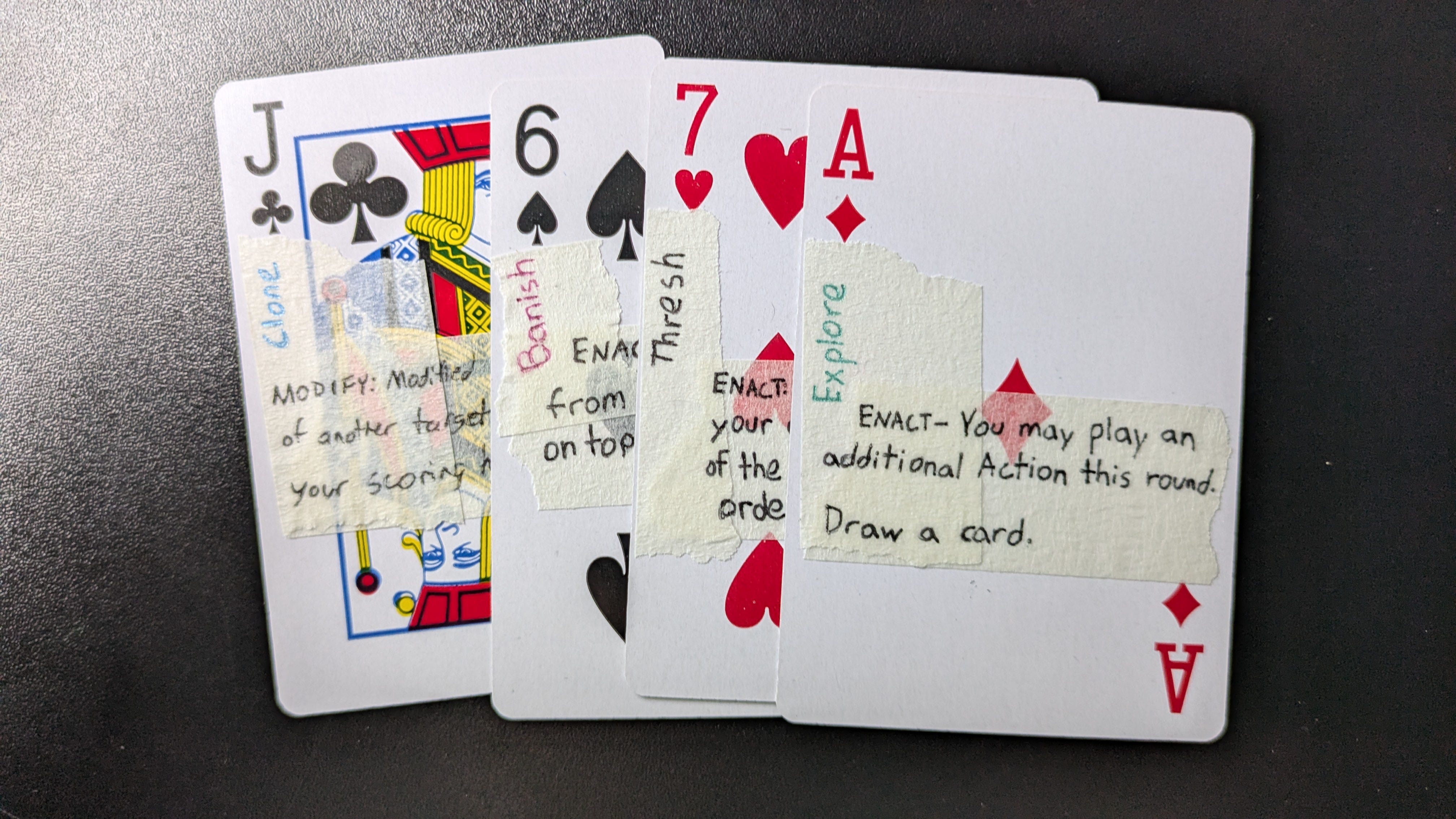
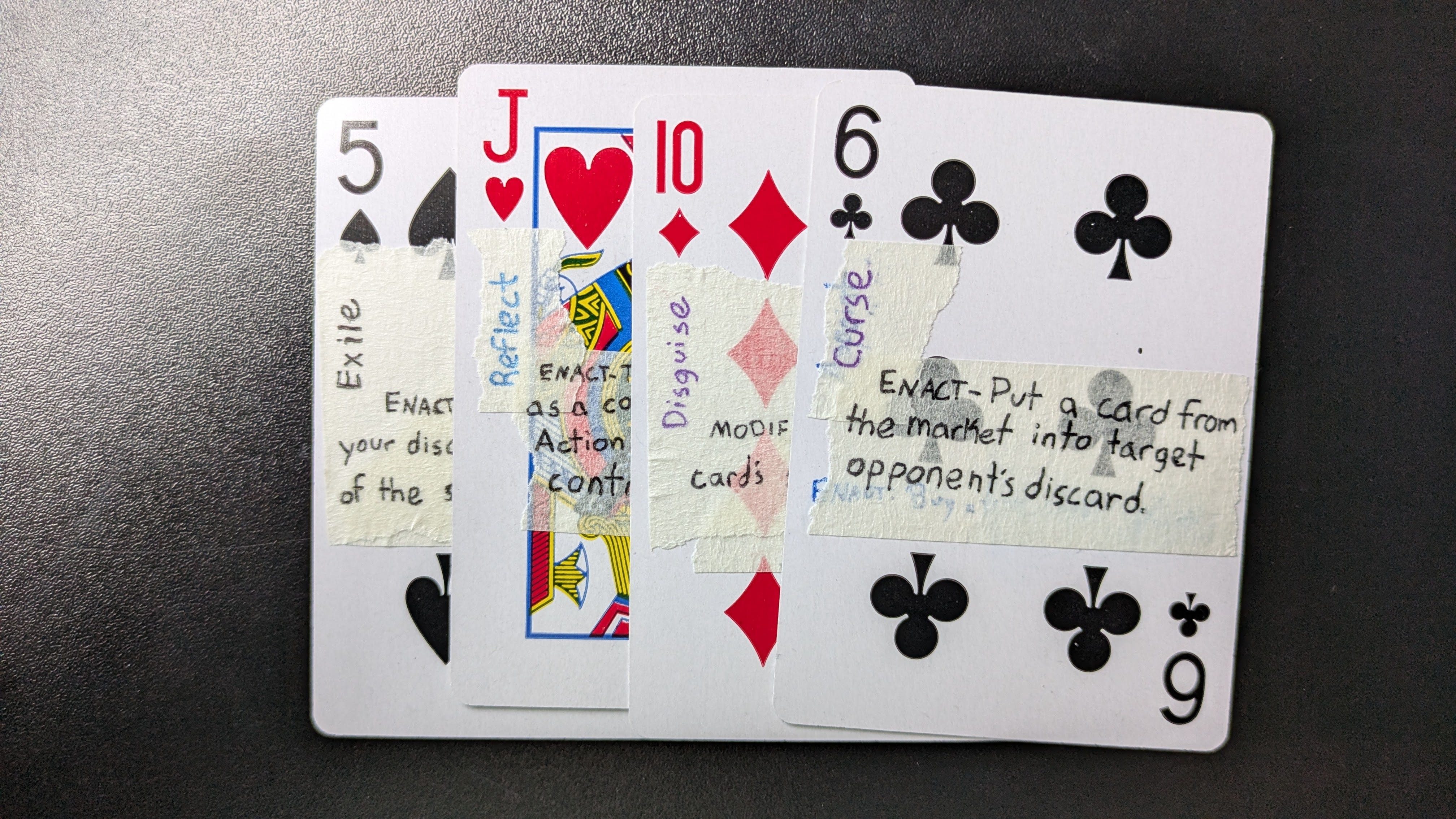
One common piece of advice in board game design is to get your game out of your brain and into the real world. It’s hard to theorycraft a robust game — no idea survives contact with reality, and it’s primarily through actual gameplay that you learn what works1. So I had gone from idea to prototype; now I had to make a game out of it.
The rules at the time looked more or less like this:
♣ ♦ Stack the Deck ♥ ♠

# Setup
1. Shuffle all cards and deal 15 to each player.
2. From the remaining cards, put three face up as the three market piles, and put the rest face down as the supply.
3. Choose a player to go first in the first round.

# Gameplay
Play proceeds in a series of rounds. Each round has the same structure:
DRAW: Each player draws 7 cards. If you can't draw 7, draw as many as you can, then shuffle your discard to start a new draw pile.
PLAY: Each player, in turn, plays up to two Actions sequentially. Each action resolves in turn.
SCORE: After each player has played Actions, players simultaneously reveal their scoring hands, which are always no more than 5 cards. The player with the best hand wins a Chip. The player with the worst hand plays their Actions first next round.
DISCARD: Players discard all cards played as actions, scored in their hands, or (somehow) remaining in their hand
Then move to the next round.

# End of the game
There are 13 chips. Whenever a player wins a round, they get a chip.
The game ends when one player has more chips than any other player will be able to get. Then they win!
Note that any player who cannot draw 7 cards for turn (because their deck has gotten smaller than 7 cards) is immediately eliminated.

# Buying cards
Some Actions let you "Buy" cards from the market. To buy a card, put a card from the market into your discard.
The market consists of the three face-up piles taken from the supply. Players may only buy the top card of any market pile.
If any market pile becomes empty, put the top card of the supply face up to reestablish that market.

# Card types
Each card can either be scored as part of a poker hand or played as an Action card. There are different types of actions; noted in the description of each card's ability.
Enact -- Execute the ability of this card as soon as it enters play.
Modify -- After the Play phase, its controller may play a Scoring card on top of it, which is then modified in some way before the hand is evaluated.
React -- These cards let you do something after some other specific event or state has occurred.
Amend -- These cards alter the rules of the game in some way while they are in play.
My own preference for games is toward the lower end of complexity/weight, so that’s what I’m aiming for with this game. I like the idea of finding the intersection of two mechanics (“it’s poker scoring meets deckbuilding!”) and cutting away everything that isn’t just that.
One way to think of (many) games is as objects moving between zones, and the constraints on how they can move. My first iteration of this game had seven zones:
Deck
Discard pile
Hand
In play (i.e. where your Action cards sit when you play their abilities)
“Scoring hand” (the five cards that compose your poker hand)
The supply
The market (3 piles)
The rules define how you can move cards between those zones: draw cards to hand, play Abilities from hand to table, clean up to the discard at end of turn. But then, the majority of card abilities expand what you can do: buy a card from the market into your discard, discard from your hand, return a card from your discard to your hand... The rest of the abilities modify properties of the cards. And that’s the whole game!
I did a lot of solo playtesting, to get a feel for how the turn structure worked, how the game progressed, and how the individual card actions played. I also did some two-player testing with my extremely kind and patient wife, to see if the game could actually be communicated to another human being. I even had a friend in Maine do a print & play blind playtest, which was simultaneously sobering and encouraging!
Those first playtests led to a lot of changes to specific card abilities and wording, and led me to think about streamlining the game even more and addressing some recurring balance issues. But I’ll talk about those problems, and how I addressed them, another time. If you want to be notified when “another time” happens, you might want to
For example, Richard Garfield in an interview with Justin Gary: “Ten hours of thinking is worth five minutes of gameplay.”